Posts

Week 12 Reading Notes: The Laidly Worm of Spindleston Heugh, Part B

Image
Childe Wynd and his sister Margaret Link to story. Title: The Laidly Worm of Spindleston Heugh Publication: English Fairy Tales, 1890 Author: Joseph Jacobs Notes: Joseph Jacobs (August 29, 1854—January 30, 1916) was an Australian folklorist, critic and historian who popularized many English fairy tales. Jacobs published English Fairy Tales in 1890, with illustrations by John D. Batten (October 8, 1860—August 5, 1932). Characters: King Late Queen Witch Queen Prince Childe Wynd Princess Margaret/Laidly Worm Places: Bamborough Castle Spindleston Heugh Events: A king lives with his wife and two children in Bamborough Castle Childe Wynd looks for fortune, meanwhile the queen passes away While mourning, the king goes hunting and meets a beautiful witch The king brings her back as his new queen Margaret is kind to her stepmother, but the new queen envies her beauty The witch queen turns Margaret into a dragon, or laidly worm The dragon leaves the castle for the mountain of Spindleston...

Week 12 Reading Notes: The Stars in the Sky, Part A

Image
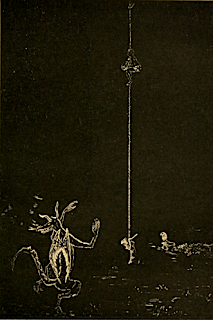
Illustration by  John D. Batten Link to story. Title: The Stars in the Sky Publication: More English Fairy Tales, 1894 Author: Joseph Jacobs Notes: Joseph Jacobs (August 29, 1854—January 30, 1916) was an Australian folklorist, critic and historian who popularized many English fairy tales. Jacobs published More English Fairy Tales in 1894, with illustrations by John D. Batton (October 8, 1860—August 5, 1932). Characters: Lassie Stars Mill-dam Brooklet Good Folk Lassie’s mother Four Feet/Horse No Feet/Fish Places: England Events: Young Lassie is lonely and plays by herself under the stars Lassie is determined to find the stars The Mill-dam tells Lassie to swim down the river The Brooklet tells Lassie to paddle down the banks The Good Folk tell Lassie to find the Horse The Horse tells Lassie to find the Fish The Fish tells Lassie to take the stairs to the stars Lassie climbs the stairs and then falls down Lassie falls on the ground and cries—it was only a dream

Week 11 Reading Notes: The Uktena and the Ulûñsû'tï, Part B

Image
The Uktena Link to story. Title: The Uktena and the Ulûñsû'tï Publication: Myths of the Cherokee, 1900 Author: James Mooney Notes: James Mooney (February 10, 1861–December 22, 1921) was an American ethnographer and author who studied Native American groups, particularly Cherokee. He published Myths of the Cherokee during Ghost Dance, a 19-century religious movement that incorporated Native American belief systems. Cherokee IPA: Uktena [noun]: “ook-teh-nah” Ulûñsû'tî [noun]: “oo-lune-soo-tee” Agän-uni'tsï [noun]: “ah-gen-oo-neat-see” Gälûñ'lätï [noun]: “gah-lune-lah-tee” Characters: Sun, who plagues the earth after seeing people’s misdeeds Little Men, vengeful of Sun’s actions Uktena, “The Keen-Eyed” monster snake (with a diamond crest called a Ulûñsû'tî) Rattlesnake, who was sent to bring vengeance instead of Uktena Agän-uni'tsï, a Cherokee warrior Places: North America Events: Sun becomes angry with the people and sends a plague Little Men is mad at Sun...

Week 11 Reading Notes: The Crane and the Hummingbird, Part A

Image
Whooping Crane Ruby Throated Hummingbird Link to story. Title: The Crane and the Hummingbird Publication: Myths of the Cherokee, 1900 Author: James Mooney Notes: James Mooney (February 10, 1861–December 22, 1921) was an American ethnographer and author who studied Native American groups, particularly Cherokee. He published Myths of the Cherokee during Ghost Dance, a 19-century religious movement that incorporated Native American belief systems. Characters: Crane Hummingbird The woman Places: North America Events: A Crane and a Hummingbird love the same woman The woman preferred the Hummingbird for his looks The Crane challenges the Hummingbird to a race to win over the woman For seven days the birds race around the woman’s house Despite the Hummingbird’s swiftness, the Crane is able to fly for long hours The Crane wins the race on the seventh day The woman says she will never marry the ugly crane and remains single

Week 10 Storylab: Writer’s Write

Image
A red dragon as seen in D&D Fantasy (n): The faculty or activity of imagining things, especially things that are impossible or improbable. Fantasy Fiction: A popular genre that involves fantasy universes, world building, myths, magic, and other-worldly creatures. Typically the story will follow the protagonist as they progress through the main quest. Sub-genres of Fantasy: Children’s Fantasy: children’s literature with fantasy elements. Comic Fantasy: focuses on humor and comedic tone in fantasy. Fairy Tale Retellings: fairy tales retold with the same structure, different elements. Fantasy Romance: focuses on relationships (social, political, romantic) in fantasy. Gothic Fantasy/Dark Fantasy: incorporates darker or frightening themes in fantasy. Grimdark Fantasy: incorporates a dystopian, amoral or violent tone in fantasy. High Fantasy/Epic Fantasy: focuses on the epic nature of a fictional world in fantasy. Historical Fantasy: represents fictitious versions of an era. ...

Week 10 Reading Notes: The Maiden Who Loved a Star, Part B

Image
Purple sage in Texas Link to story. Title: The Maiden Who Loved a Star Publication: When the Storm God Rides: Tejas and Other Indian Legends, 1936 Author: Florence Stratton Illustrator: Berniece Burrough Notes: Florence Stratton (1883—January 28, 1938) was an American journalist and writer Having returned to Texas for her career in journalism, she published the Tejas Indian folklore anthology “When the Storm God Rides” in 1936. Characters: Young girl Sky dweller Old woman Great Spirit Places: Texas Events: A young girl forages for prickly pear fruit in the desert The girl catches a glimpse of a winking star The girl dreams about the sky dweller living in the stars The girl goes out to the desert to see the star for a week She continues to dream of the sky dweller, but they can’t be together The girl asks the old woman how to die to join the star The old woman suggests another option in order to live The girl drinks the old woman’s potion and turns into a desert shrub The sky d...

Week 10 Reading Notes: When the Rainbow Was Torn, Part A

Image
A rainbow hanging over a cactus Link to story. Title: When the Rainbow Was Torn Publication: When the Storm God Rides: Tejas and Other Indian Legends, 1936 Author: Florence Stratton Illustrator: Berniece Burrough Notes: Florence Stratton (1883—January 28, 1938) was an American journalist and writer Having returned to Texas for her career in journalism, she published the Tejas Indian folklore anthology “When the Storm God Rides” in 1936. Characters: Rainbow Cactus flowers Places: Texas Events: There are flowers with every color of the rainbow The white cactus flowers looked to the rainbow for their colors The rainbow stays away from the cactus’ sharp thorns The rainbow is trodden after a heavy rainfall The red, orange and yellow bands get caught on the cactus The cactus flowers remain colorful to this day

Week 9 Story: How Kweku Tsin Became the Sun

Image
Having reached the peak of the cavern’s entrance,  Kweku Tsin turned to face the beast. Once there was a man named Kweku Tsin, a brave hunter and the provider of his village. He was as strong as he was clever, being the son of the quick-witted Anansi. Everyone admired Kweku Tsin and felt safe in his presence. One day, the people in the village began to go missing. Every day that passed, more of the villagers disappeared. Concerned, Kweku Tsin gathered his hunting gear and left the village to investigate. Reaching the lush forests, Kweku Tsin walked deftly through the trees, looking for any sign of the missing villagers. In his wake he spotted something weaving through the foliage. Kweku Tsin reached for his bow when suddenly, the large figure arose. A dragon, unlike anything he had ever seen before, reached out to grab him. The beast flew off with Kweku Tsin and dropped him in a dark den on the highest mountain. Gathering his surroundings, Kweku Tsin saw the missing villagers...

Week 9 Reading Notes : The Moon and the Stars, Part B

Image
Kweku Tsin flees from the dragon Link to story.   Title:   The Moon and the Stars Publication: West African Folk-Tales, 1917 Author: William H. Barker and Cecilia Sinclair Notes: William H. Barker (1882-1929) was an American missionary who collected stories from the west coast of Africa to compile into his book, “West African Folk-Tales,” published in 1917. Cecilia Sinclair was the coauthor and the illustrator of the novel. Characters: Anansi Kweku Tsin, Anansi’s son Dragon Rooster Anansi’s friends Places: Ghana Events: Kweku Tsin supplies food for his family Kweku Tsin spots a dragon while out hunting Kweku Tsin and his father Anansi go to see the dragon The dragon captures them and holds them hostage in his castle Kweku Tsin devises an escape plan for the captives Kweku Tsin collects rice for the dragon’s servant, the rooster Kweku Tsin makes a rope ladder Kweku Tsin gathers leftover bones and the dragon’s fiddle The captives begin to climb the ladder with the dragon...

Week 9 Reading Notes: How We Got the Name “Spider Tales”, Part A

Image
Anansi Link to story. Title: How We Got the Name “Spider Tales” Publication: West African Folk-Tales, 1917 Author: William H. Barker and Cecilia Sinclair Notes: William H. Barker (1882-1929) was an American missionary who collected stories from the west coast of Africa to compile into his book, “West African Folk-Tales,” published in 1917. Cecilia Sinclair was the coauthor and the illustrator of the novel. Characters: Nyankupon, chief of the gods Spider/Anansi, the trickster Bees Boa Tiger Places:  Ghana Events: Anansi envies Nyankupon’s fame Anansi asks to be written into future stories Nyankupon sends Anansi on a quest to fetch three things Anansi tricks the bees to fly into a jar Anansi tricks the boa to hang from a stick Anansi tricks the tiger into following him Nyankupon, impressed, calls the old tales Anansi tales References: http://www.loyalbooks.com/book/west-african-folk-tales-by-william-h-barker https://en.wikipedia.org/wiki/Anansi